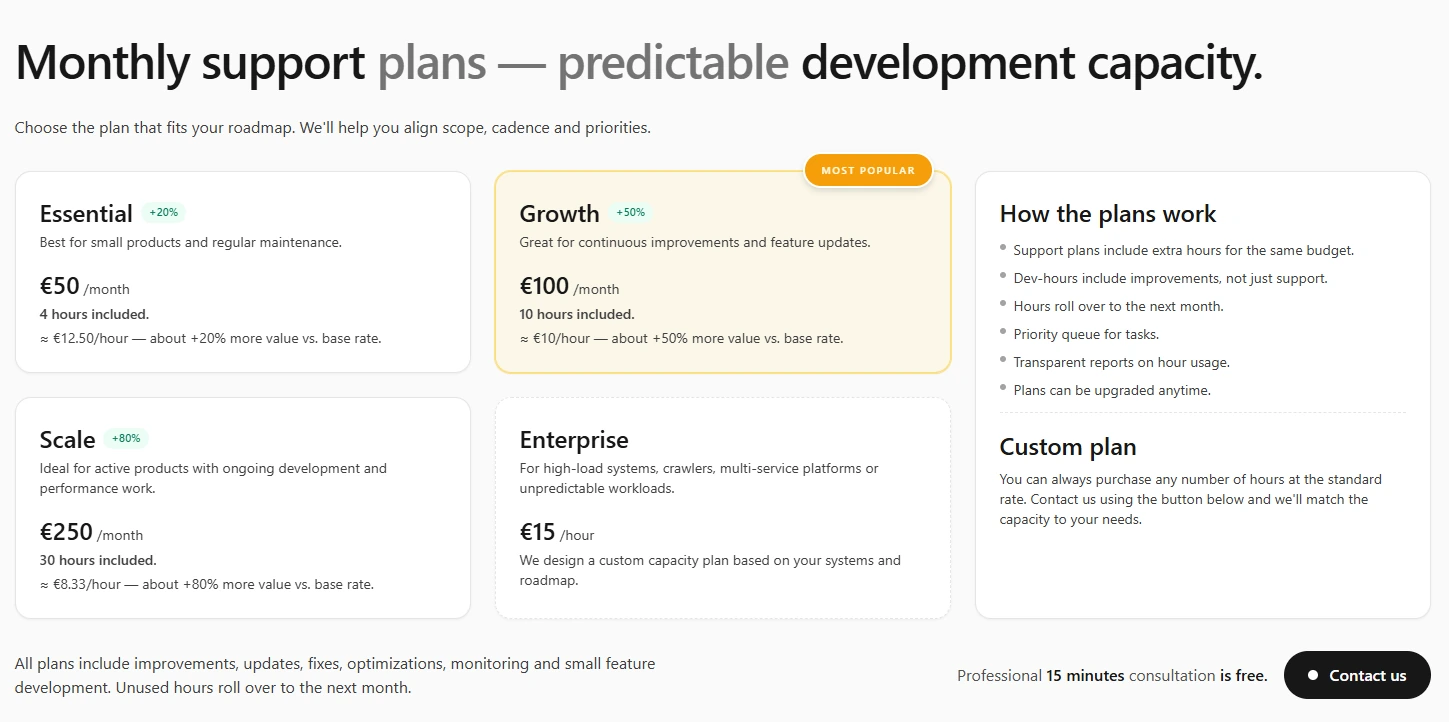
Website Maintenance Cost in 2026: Support Plans, Dev Hours, Bug Fixes, Security, and SEO
A buyer-focused guide to website maintenance cost in 2026: what monthly support includes, when a retainer makes sense, how one-time fixes compare with support plans, and what PAS7 can own after launch.
Website maintenance can be a small monthly support plan for a simple business site or a larger retainer for an ecommerce, multilingual, SEO-critical, or integration-heavy website. The price depends on response expectations, developer hours, update frequency, monitoring, content changes, security work, analytics, SEO checks, and whether the team owns improvements after launch.
What website maintenance actually pays for
The practical answer: maintenance is not one task. It is a decision about who owns the website after launch and how quickly the business can react when something breaks or needs improvement.
Maintenance, one-time fixes, and development retainers are not the same thing
Buyers often compare support quotes without checking what is included. A cheap plan can be fine for a quiet website and weak for a site that actively drives sales.
| Comparison point | Best for | Typical scope | Risk | PAS7 route |
|---|---|---|---|---|
| One-time fix | One isolated problem | Repair a bug, update one section, fix a tracking issue, adjust a form | No ongoing ownership; the next issue starts a new request | Task-based support |
| Maintenance plan | A site that must stay healthy | Updates, checks, small fixes, monitoring, backups/process review, reports, minor content tasks | Can become too shallow if it excludes developer hours or response expectations | Website support service |
| Development retainer | A website that keeps changing | Included dev hours, campaign pages, integrations, performance work, analytics, SEO tasks, backlog improvements | Needs clear prioritization so urgent fixes and improvement work do not compete silently | Monthly support + dev hours |
Three realistic support models for 2026
Public pricing pages in 2026 show wide ranges because support can mean anything from WordPress updates to a monthly development partnership. The useful comparison is responsibility, not just price.
Current market references show maintenance can range from low monthly WordPress care plans to larger retainers with development hours, priority response, and strategy. Ukrainian pricing references also separate small technical support from deeper monthly work. The right question is what responsibility the support team accepts. [1][2][3][4]
health checks and small changes
Best for a stable business site that needs periodic checks, minor edits, plugin or dependency awareness, and a path for small fixes.
fixes, tracking, content, SEO hygiene
Best for lead-generation and service websites where forms, analytics, search visibility, speed, and campaign changes affect revenue.
dev hours and backlog ownership
Best for ecommerce, multilingual, integration-heavy, or frequently updated sites that need priority fixes plus ongoing improvements.
The eight factors that usually drive website support cost
A support quote should become more expensive only when responsibility becomes larger or response expectations become stricter.
1. Site type
A static company site, WordPress site, ecommerce store, multilingual content site, and custom web app all need different support patterns.
2. Business criticality
If forms, checkout, tracking, or SEO pages generate revenue, the support plan needs faster reaction and more active monitoring.
3. Included dev hours
Some plans only monitor and patch. Retainers include hours for fixes, new sections, landing pages, integrations, and backlog work.
4. Response time
Same-week support is different from priority response during campaign launches, payment issues, or production incidents.
5. SEO and analytics ownership
Search Console checks, metadata fixes, redirects, broken links, schema, GA4 events, and conversion tracking add value but also require time.
6. Performance work
Core Web Vitals and real-user performance can affect UX and organic performance. web.dev's INP guidance is one useful reference for performance maintenance. [5]
7. Integrations
CRM, payments, email, forms, calendars, product feeds, and third-party APIs create support work because they can fail outside the visible page.
8. Reporting and backlog management
A good plan should show what was fixed, what is still risky, and which improvements should be prioritized next.
What website support usually does not include by default
Many support conflicts happen because the buyer expects a full product team while the plan only covers maintenance checks.
Full redesigns or major UX rebuilds unless dev hours are explicitly included.
Large content production, copywriting, or translation work unless scoped separately.
Ongoing SEO strategy or link building if the plan only includes technical hygiene.
Custom integrations, payment changes, CRM rebuilds, or new business workflows without a separate estimate.
Emergency response at any hour unless the agreement defines priority or incident support.
Unlimited tasks. A support plan still needs a queue, priority rules, and a monthly capacity limit.
How PAS7 structures a support plan
A useful support plan is operational. It should say what PAS7 owns, what the client owns, and how work enters the queue.
Audit the current website
We review platform, hosting, forms, analytics, Search Console, speed, integrations, critical pages, and the current backlog.
Define monthly responsibility
We separate monitoring, fixes, small changes, dev hours, analytics, SEO hygiene, and larger project work.
Set the queue and priority rules
We agree how urgent fixes, campaign requests, content changes, and improvement tasks are prioritized inside the monthly capacity.
Report and improve
We keep visible what was changed, what remains risky, and which improvements should be planned next.
What to prepare before requesting a maintenance estimate
You can request support without a perfect technical handover, but these inputs make the estimate sharper.
Website URL and platform
Share whether the site is custom, WordPress, Shopify, Next.js, WooCommerce, or another stack.
Current pain points
List broken forms, slow pages, tracking gaps, SEO issues, content changes, design fixes, or integration failures.
Business critical pages
Identify pages that drive leads, sales, ad traffic, organic traffic, or partner trust.
Access situation
Hosting, repository, CMS, analytics, Search Console, domain, email, and third-party service access.
Monthly workload
Estimate how often you need changes: occasional fixes, weekly updates, campaign launches, or continuous improvement.
Response expectations
Clarify whether normal business response is enough or whether the site needs priority incident handling.
FAQ
It depends on the site type and responsibility. A small business site can use a lighter monthly plan, while ecommerce, multilingual, integration-heavy, or SEO-critical websites usually need a larger support retainer with developer hours and priority rules.
Typical maintenance includes bug fixes, updates, monitoring, form checks, analytics checks, performance review, SEO hygiene, small content changes, reporting, and a process for new tasks. The exact scope should be written in the support plan.
Monthly support is better when the website is business-critical, changes often, or needs active ownership. One-time fixes are fine for isolated problems when no ongoing responsibility is needed.
It can include technical SEO hygiene such as redirects, metadata fixes, broken-link checks, indexing checks, schema fixes, and performance review. Full SEO strategy or content production should be scoped separately.
Yes, after a short audit. PAS7 needs to review the stack, repository or CMS, hosting, analytics, critical pages, and current risks before proposing a support plan.
Only if the plan includes development hours. A maintenance-only plan keeps the site healthy, while a retainer can include landing pages, integrations, performance work, analytics updates, and backlog improvements.
Sources and reference points
These references were used for market and technical framing. Final support pricing should be scoped against your website, platform, and monthly responsibility.
Give the website an owner after launch
If your site already generates leads, sales, or organic traffic, support should not be random. PAS7 can review the current state, define a monthly support scope, and keep fixes and improvements moving.
Related Articles

How to Add Mau Saver to a Telegram Group and Save Media in Chat
A practical guide to adding Mau Saver to a Telegram group and downloading videos, audio, and posts directly in the chat.

How to Advertise to an International Telegram Media Audience
A practical guide for advertisers: reach an international Telegram audience through Mau Saver Bot, group placements, pinned posts, and native media integrations.
AI Assistant Development Cost in 2026: RAG Chatbots, CRM Integrations, Guardrails, and Support
A practical buyer guide to AI assistant development cost in 2026: prototypes, RAG chatbots, knowledge-base assistants, CRM and website integrations, guardrails, evaluations, monitoring, and support.

AI Can Make More. Not Better: What Game Development Research Actually Says
Generative AI is entering game production, but the evidence is more nuanced than the hype. We examine developer adoption, player reception, quality risks, and a practical production model for using AI without outsourcing taste.
Turnkey Website Development
Website development services for business: landing pages, corporate websites, and ecommerce builds with integrations, fast performance, and SEO-ready architecture.
Technical SEO Audit & SEO Optimization
Technical SEO audit and SEO optimization services: indexation fixes, Core Web Vitals improvements, schema markup, internal linking, and sustainable organic growth.
Website Support & Maintenance Plans
Monthly website support and maintenance plans: bug fixes, updates, performance optimization, monitoring, and development retainer hours.
Professional development for your business
We create modern web solutions and bots for businesses. Learn how we can help you achieve your goals.